

In short
- A Santa Maria grill changes the heat by changing the distance between food and fire. A fixed-grate charcoal grill changes the heat by moving coals, moving food or adjusting airflow.
- Neither system cooks for you. You still manage the fire, the position of the food and the timing.
- The right choice depends on how you like to cook and where the grill goes: freestanding or built-in.
Both a Santa Maria grill and a regular charcoal grill can produce excellent food. The difference is in how you control the heat. With a Santa Maria grill you raise or lower the cooking grate above the embers. With a fixed-grate charcoal grill you work with coal placement, direct and indirect zones and, on covered models, the vents. If you enjoy tending a fire and cooking several dishes over an afternoon, adjustable height is worth a closer look. If cooking with the lid closed is your priority, weigh that separately before you choose an open-fire grill.
What happens when you raise or lower the grate
Lowering the grate brings the food closer to the embers and increases the heat it receives. Raising it does the opposite. That lets you adjust the intensity without moving every piece of food to another part of the grill.
Keep in mind that this is a physical adjustment, not a thermostat. A given height does not equal a given temperature: the size of the ember bed, wind, food position and how far the fire has burned down all play a role. Take a mixed vegetable cook: some pieces brown faster than others. Raising the grate slows everything down at once, while you still decide where each piece sits and how much ember goes underneath.
Santa Maria grill vs fixed-grate charcoal grill
| Santa Maria grill | Fixed-grate charcoal grill | |
|---|---|---|
| How you adjust heat | Raise or lower the grate | Move coals or switch cooking zones |
| Cooking style | Open fire, hands-on | Direct and indirect grilling |
| Fuel | Wood or charcoal, depending on the model | Usually charcoal |
| Ember supply | Often a separate brasero | Coals sit directly under the grate |
| Cooking with a lid | Depends on the model | Standard on covered models |
| Best for | Live-fire cooking you stay involved in | Classic charcoal methods |
Why the brasero matters
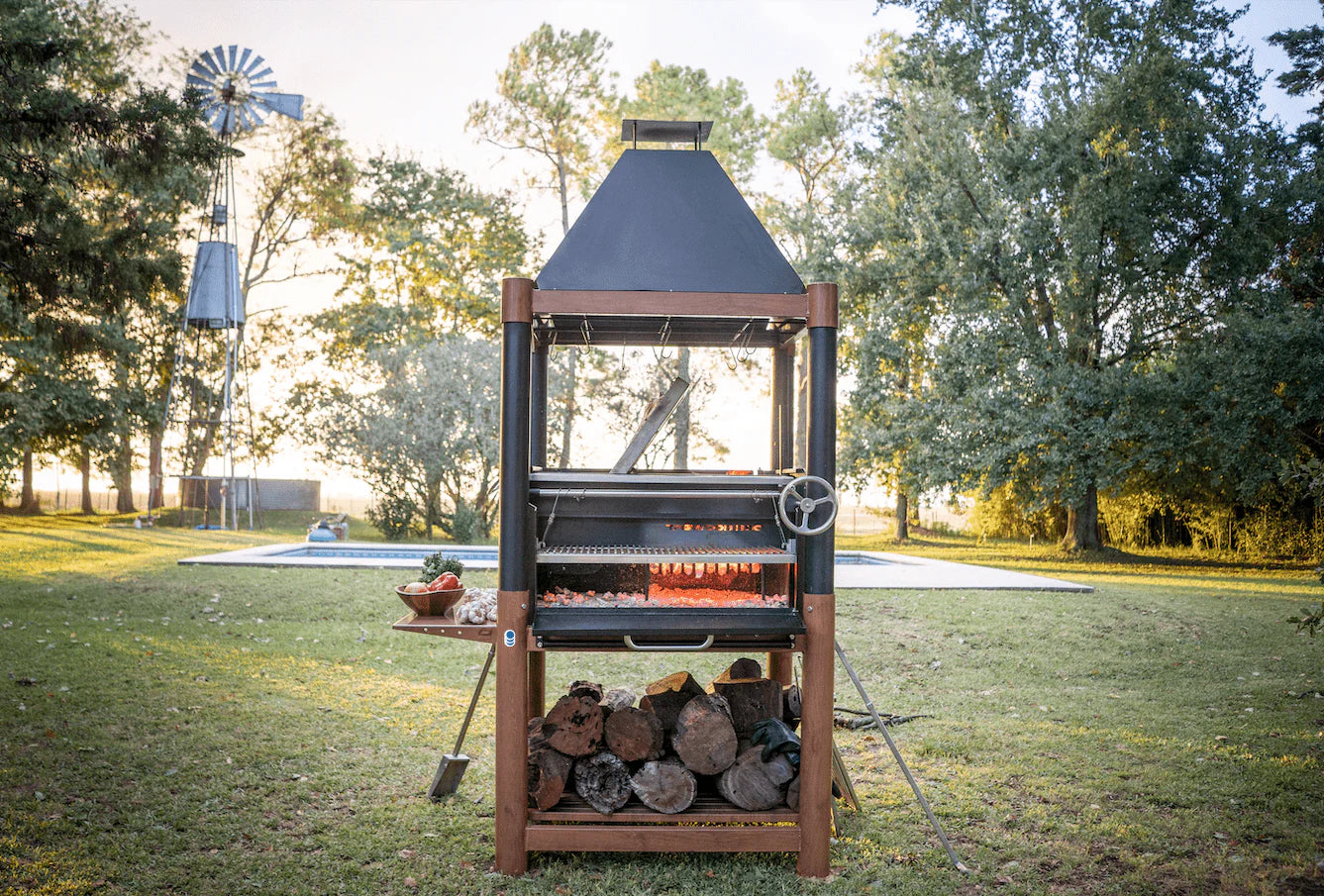
A brasero is a separate firebox where wood or charcoal burns down into glowing embers. You then rake those embers under the grate. This is how Argentine asado has been cooked for generations, and it solves a practical problem: you never have to put fresh fuel and open flames directly under your food.
The result is steadier heat with fewer flare-ups and less harsh smoke, so the outside of a thick cut does not burn before the inside is done. During long sessions it really pays off. While one batch of embers is cooking, the next is already forming in the brasero, so you can keep going through several courses without rebuilding the fire.
When comparing grills, check how easy the brasero is to reach, how you move embers across, and whether you can top up heat safely while food is on the grate.
Which Tagwood setup fits you
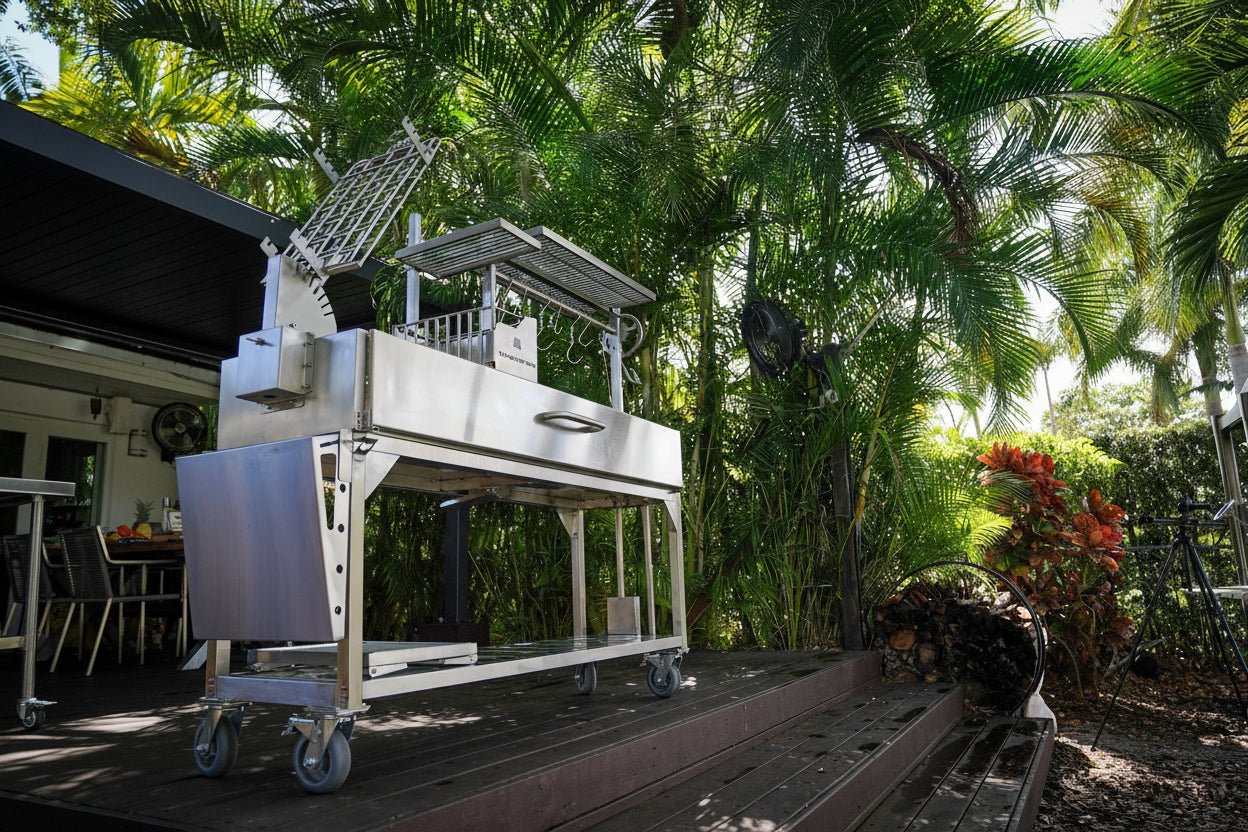
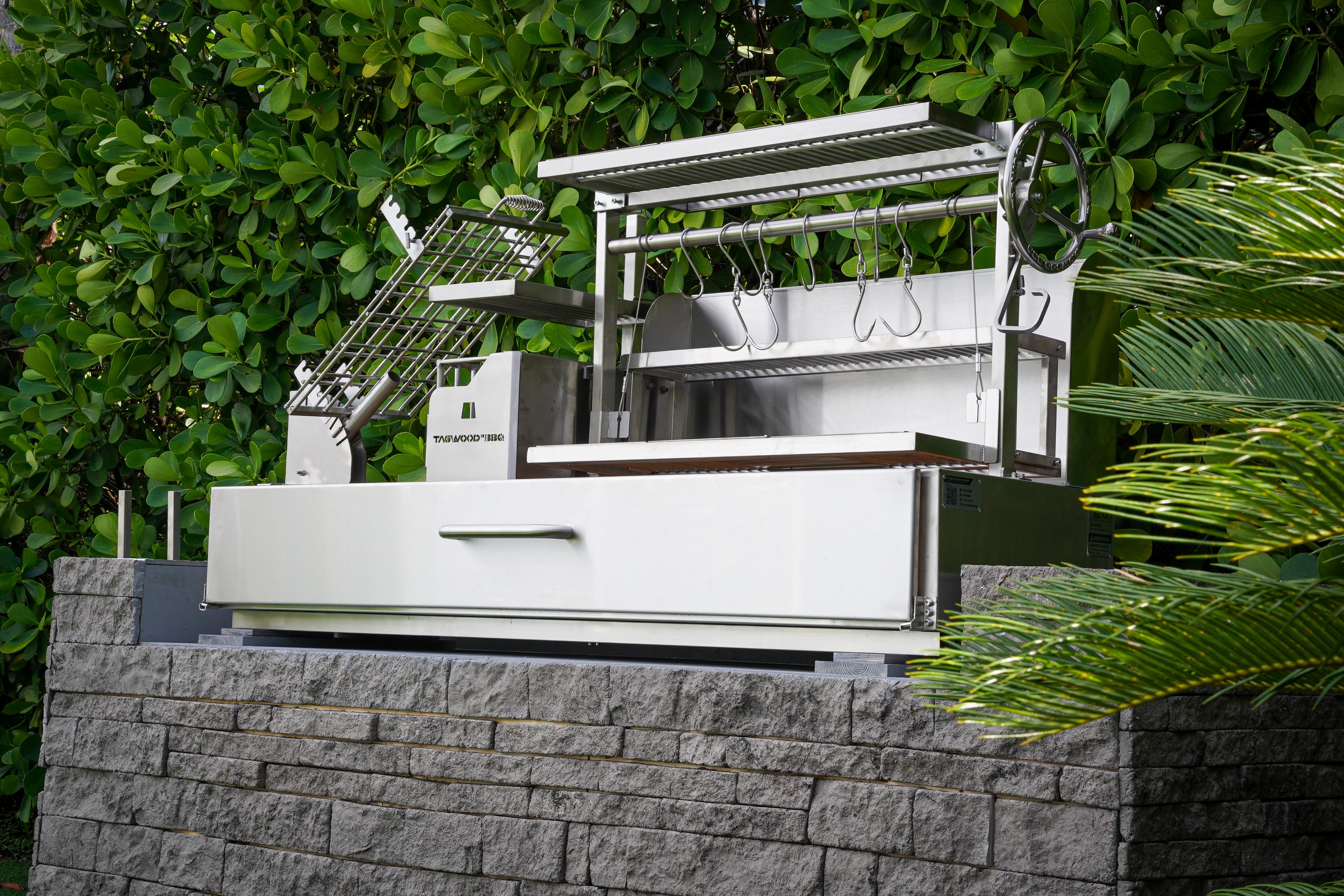
Start with where the grill will go. The BBQ03 is a freestanding Santa Maria grill and a good starting point for height-adjustable cooking. The BBQ05 offers the same principle in a built-in format for an outdoor kitchen.
Planning to cook with a rotating clamp as well? Look at the BBQ06 (freestanding) or the BBQ08 (built-in). The clamp has a different job from the height-adjustable grate, so judge it as a separate feature.
When it is worth it, and when it is not
Adjustable height makes sense if you want to be actively involved in cooking over fire